A Chair in the Room: What Britain's Security Council Seat Actually Delivers
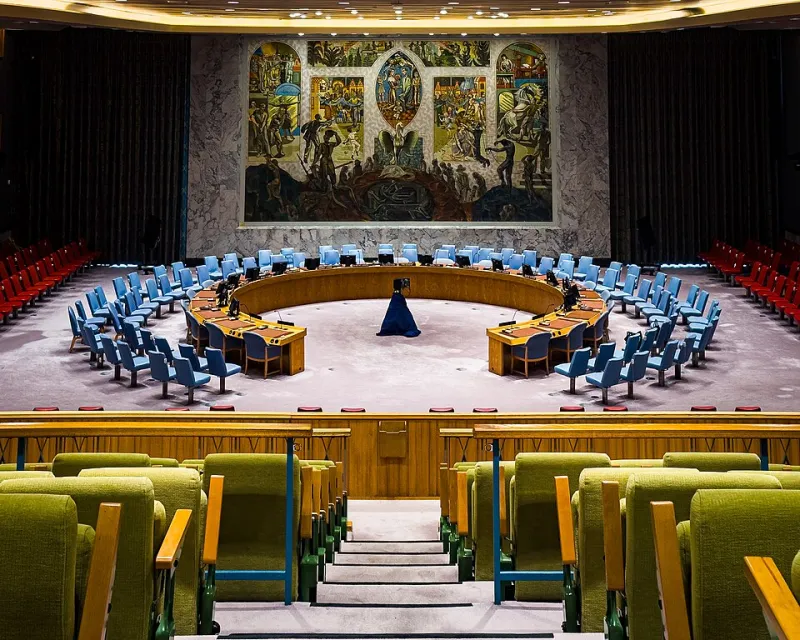
Photo: Jdforrester, CC BY 4.0, via Wikimedia Commons
Britain's permanent seat on the UN Security Council has survived every defence review, every spending squeeze and every change of government since the institution was founded. It is the last badge of great-power status that London holds without qualification, and it is invoked across the political spectrum as evidence that the country still sits where decisions are made.
With the contest to succeed António Guterres now under way and the Council's legitimacy under sustained attack from much of the world, that assumption deserves a colder examination. Does the seat buy outcomes, or does it buy a chair?
A veto nobody uses
The most striking fact about the British seat is how rarely its sharpest instrument is deployed. London has not cast a veto since 1989. For more than three and a half decades, the preferred British technique has been abstention, silence, or a carefully worded statement of regret issued after the vote has been taken.
This is not weakness so much as doctrine. The veto is a costly weapon: it invites accusations of complicity in paralysis and attaches a state's name to the blocking of a text it may privately welcome. Abstention delivers most of the protection at a fraction of the reputational price.
Climate change, arms control and even the war in Gaza are not the same, no.
The Gaza votes of 2023 and 2024 illustrate the method precisely. Britain abstained repeatedly as Washington shielded Israel, then moved to support ceasefire resolutions once the political weather in Westminster shifted. It never tabled a text of its own that could have forced the issue. The seat protected London from outcomes it opposed without requiring it to be blamed for stopping them. That is influence of a negative kind — a fire alarm rather than a fire engine — and it is real, if rarely admitted.
The pen, the committee and the corridor
Where Britain does matter is in the unglamorous middle game. It has held the pen on Yemen and, with Washington, on Sudan, and it has chaired sanctions committees whose technical work rarely troubles a headline. Listing and delisting, exemption regimes, humanitarian carve-outs, the drafting of expert panel mandates: this is the machinery through which a mid-sized power with a strong legal service and a well-drilled mission can shape what the Council actually does.
British diplomats are, by common consent among the elected members who rotate through New York, good at amendments, sequencing and the chairing of informal consultations. The Council runs on consensus language, and the country that writes the first draft of a paragraph often wins the argument three weeks later.
That is a genuine skill. It is also a modest one. Drafting capacity shapes the margins of a decision; it does not determine whether a decision is taken at all. When Washington has a settled position, British textual leverage contracts sharply. Where the file is low-salience and technical, London's influence is considerable — which is to say that the seat is at its most useful on the subjects least likely to be discussed in the Commons.
What a sceptical audit would show
A serious audit would ask a short list of questions. How many British-drafted texts were adopted unamended? How often did British red lines survive contact with the P3? Did the seat change an outcome London cared about — on Sudan, on Ukraine, on humanitarian access?
The honest answers would be uneven. On Ukraine, Britain has been effective as a moral and logistical organiser, but the Council itself has been neutered by the Russian veto, and London's energy has moved to other forums. On Sudan, Britain has pressed a file the world has largely ignored, with meagre results. On Gaza, the seat was used to manage a domestic and transatlantic dilemma rather than to shape events.
The comparison with Paris is unflattering. France has been more willing to break publicly with Washington, and it was the French, with Mexico, who pushed the veto-restraint initiative in mass-atrocity cases a decade ago. Britain signed the code of conduct. It has said comparatively little about it since.
Reform pressure and the succession
The structural backdrop is unforgiving. The G4 grouping of Brazil, Germany, India and Japan presses for permanent seats. The African Union's Ezulwini Consensus demands at least two, with veto rights. Washington's belated endorsement of African and small-island representation, without the veto, has changed the weather without resolving anything. The 2024 Pact for the Future committed members to intensify reform efforts, which is diplomatic language for continuing to disagree.
Britain's position — supportive of expansion in principle, silent on detail, defensive of the veto — is sustainable only for as long as reform remains impossible. Every enlargement proposal that gains traction makes the British refusal to discuss the veto look more like self-interest and less like institutional prudence.
The selection of the next secretary-general will test this. The campaign for a more transparent process, with published shortlists and open hearings, has gathered support among elected members and civil society. The P5 retain the decisive leverage. How Britain exercises it — as a broker of legitimacy or as a defender of private privilege — will say more about the seat's future than any speech about the rules-based order.
A platform, not a policy
The seat is not a ceremonial perch. It confers access, intelligence, convening power and a place in the room when crises break. It makes Britain a connective hub between the P5, the elected members and the Commonwealth, and that role has a genuine, if limited, value.
But a seat is a platform, not a policy. The government should publish an annual account of what Britain achieved at the Council — outcomes, not attendance, resolutions shaped rather than speeches delivered. If the Foreign Office cannot fill two pages with concrete results, ministers should stop citing the seat as a proxy for influence. The rest of the world stopped being persuaded some time ago.