From the
laboratory to the market
Biotechnology
and higher education are instrumental in Malaysia’s
transition to a knowledge-based economy
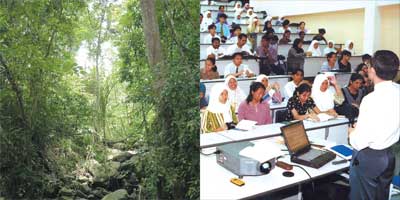
Deep in Malaysia’s ancient
rainforests grows a herb known locally as Tongkat
Ali, or Ali’s Cane, which is used as a treatment
for dysentery, glandular swelling, fever, malaria
and other ailments. It is especially prized, however,
as the Malaysian answer to Viagra, and is sold in
coffee and tea as well as pill form as an enhancer
for the male libido.
Tongkat Ali is just one of
the innumerable varieties of plants, herbs and living
creatures to be found in Malaysia, which is one of
the most bio-diverse countries in the world and estimated
to contain at least 60 percent of all known species.
Even the population comprises a heterogeneous ethnic
mix of Malays, Chinese, Indians, dozens of indigenous
tribes, and others.
This extraordinary multiplicity
in nature provides Malaysia with a huge and unique
resource for an industry it has identified as one
of its most important future engines of economic growth
– biotechnology.
From medicines and pharmaceuticals
to agriculture, the environment and food processing
– biotechnology is very big business indeed.
Globally, the industry is forecast to be worth $193.8
billion by the end of this year. As yet, Malaysia’s
biotechnology sector is at a relatively early stage
of development, but its potential is enormous.
The federal government has
committed substantial funds towards expanding the
industry, which it regards as having a key contribution
to make towards the reorientation of the national
economy. It predicts the sector will generate RM270
billion (£42 billion) in revenue for the country
by 2020.
 |
|
Researchers
and scientists have a crucial role to play in
the new Malaysian economy
|
Development of biotechnology
warrants an entire chapter of the ongoing Ninth Malaysia
Plan (9MP), which is aimed at shifting Malaysia from
a low-cost mass production economy to a knowledge-based,
technology-driven one focused on innovation, entrepreneurship
and value-added production.
Biotechnology has the potential
to unlock additional value in traditionally strong
sectors of the Malaysian economy, such as commodities
and manufacturing, and to create substantial value
in new and upcoming sectors such as healthcare, nutraceuticals
and industrial bio-processing. It has a vital role
to play in food sufficiency, environmental protection
and conservation, and the fight against diseases.
In addition to having the
advantage of easy access to vast natural resources,
Malaysia already has experience in vaccine production,
clinical trials, diagnostic and agro-biotechnology
upon which to build.
Prime Minister Abdullah Badawi
describes biotechnology as one of the key drivers
of the country’s future development. “Biotechnology
will not only drive improvements in the quality of
life of Malaysians; it will also propel the creation
of knowledge and innovation in the country, crucial
elements in our quest to climb up to a higher value-added
stage of development,” he says.
The National Biotechnology
Plan, launched in 2005, focuses on developing niches
in agriculture, healthcare-related biotechnology,
industrial biotechnology and bioinformatics. A total
of RM2 billion (£312 million) has been allocated
to implement the plan.
Crucial to the government’s
plan to reorient the economy is the nurturing of research
and development (R&D) and the building of a workforce
equipped with the requisite skills. Both of these
areas rely on the commitment of Malaysia’s universities,
colleges, vocational and other higher educational
institutions, and a massive upgrade of standards is
under way.
It is essential that the universities
work closely with the private sector, both to ensure
that the educational institutions are fully attuned
to the needs of the rapidly changing labour market
and to facilitate the development and marketing of
commercially viable products from scientific discoveries.
Ways are being sought to put them in touch with investors
and domestic and international customers.
---------------------------------------------------------------------------------------------------------------
GREECE PROJECT TEAM
Project Director: M. Mercedes Pagalday
Editorial Director: Fredrik Meloni
Project Assistant: Idil Demirel