The Unofficial Chancelleries: Westminster’s All-Party Groups and the Quiet Business of Foreign Influence
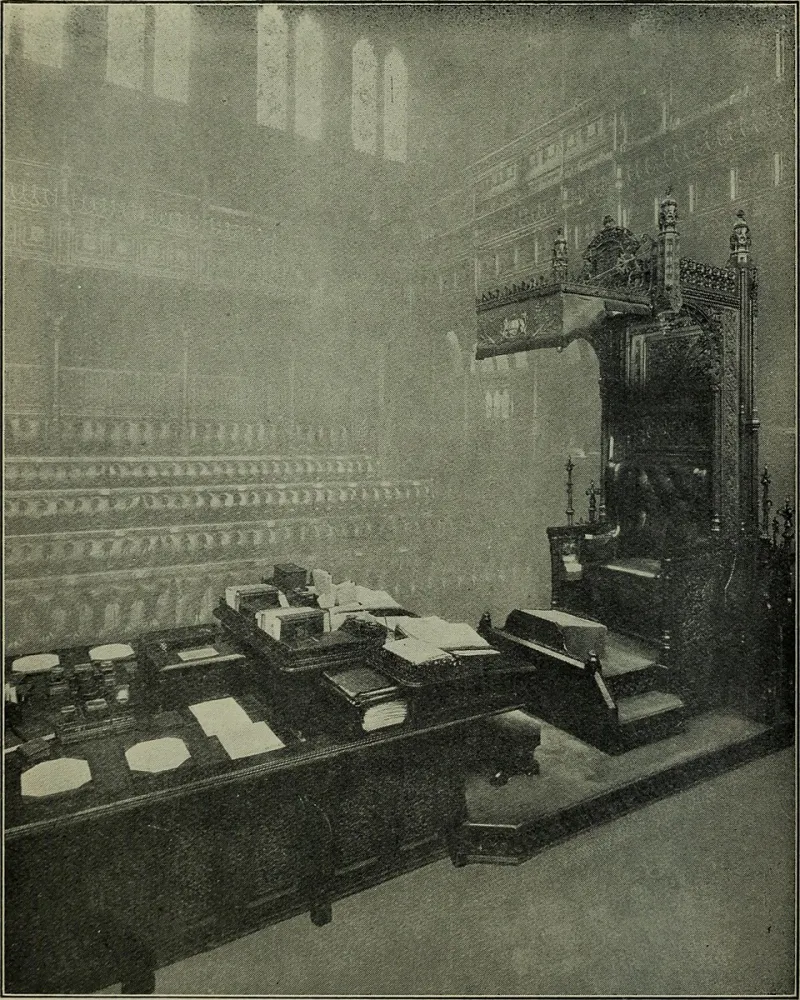
Photo: Internet Archive Book Images, No restrictions, via Wikimedia Commons
In a committee room off Westminster Hall, a visiting ambassador takes questions from a handful of MPs and peers. There is no treaty to sign, no communiqué to draft and no Foreign, Commonwealth and Development Office (FCDO) minister in the room. The meeting is hosted by an all-party parliamentary group (APPG), one of several hundred such bodies that give Westminster its dense, informal texture. On paper, the group exists to inform parliamentarians. In practice, it is one of the quietest channels through which foreign interests seek influence in London.
APPGs have no legislative power and no diplomatic mandate. They cannot bind the British state, commit public money or speak for the government. That is precisely what makes them useful. They can host receptions for visiting presidents, publish reports that read like policy papers, arrange delegations abroad and give a parliamentary platform to causes that ministers would rather handle in private. For a foreign embassy, a well-run country group is cheaper than a London public affairs campaign and carries the imprimatur of Parliament without the obligations of formal diplomacy.
A parallel map of Westminster
The Register of All-Party Parliamentary Groups lists several hundred active groups, covering countries, regions, conflicts, industries and causes. Most are innocuous. Some are genuinely valuable: they give MPs and peers expertise they would otherwise lack, connect diaspora communities to Westminster and allow Britain to maintain low-cost relationships with states where formal engagement is thin. For small countries without a large embassy in London, an APPG can be a substitute for the diplomatic attention they cannot command.
The difficulty is that the same structure serves very different purposes. A group on a neglected conflict may be powered by a handful of committed parliamentarians and a volunteer secretariat. A group on a major trading partner may be funded by a consultancy, a law firm or an overseas body with a direct commercial interest in the parliamentary agenda. Both appear in the same register, under the same rules, with the same formal status. The register discloses inputs — secretariat support, hospitality, travel — but it does not explain outcomes. It tells the reader who paid for the room, not who shaped the argument.
Who pays, and who convenes
The funding question is the most sensitive. APPGs are required to register benefits they receive, including secretariat services, and successive reviews have tightened the rules on overseas funding. But disclosure is annual, aggregated and often difficult to link to particular meetings or reports. A secretariat provided by a public affairs firm may be recorded as a benefit in kind; a reception sponsored by an embassy may appear as hospitality. Neither entry, on its own, reveals whether the group is functioning as a parliamentary forum or as a lobbying vehicle with a Westminster letterhead.
For foreign governments, the appeal is obvious. Formal diplomatic channels are scrutinised, minuted and subject to foreign policy priorities. An APPG is none of those things. It can keep a contested narrative alive in Parliament, cultivate sympathetic parliamentarians and create the impression of bilateral warmth that ministers may later be invited to endorse. For diaspora organisations, the motive may be more benign: a desire to be heard, to counter a hostile framing or to keep a homeland’s concerns on the Westminster agenda. For commercial lobbyists, the calculation is simpler still — access, credibility and a useful association with the language of parliamentary scrutiny.
The diplomatic utility — and the risk
It would be wrong to treat APPGs as inherently corrupt. Many do useful work, and the cross-party requirement is a genuine safeguard against any single faction capturing a group. But the system has an accountability gap at its centre. Parliament’s standards regime can police registration failures; it is not designed to assess whether a group has become an extension of a foreign government’s public diplomacy. There is no requirement to publish minutes, attendee lists or the substance of meetings with ambassadors. There is no real-time disclosure of funding. Sanctions for non-compliance are modest.
The consequence is a form of diplomacy without a mandate. Ministers and officials can point to APPGs as evidence of parliamentary interest; foreign governments can point to them as evidence of bilateral engagement; lobbyists can point to them as evidence of legitimacy. None of these claims is necessarily false, but none is tested. In an era when influence operations are cheaper and more sophisticated, the informal channel is also the least supervised.
Reform without killing the useful bits
The answer is not to abolish APPGs. Britain’s diplomatic reach is already stretched, and these groups provide a low-cost supplement to formal engagement. The answer is to make the parallel map legible. A real-time register of secretariat funding and foreign-government support would help. Mandatory publication of minutes for groups receiving overseas funding would help more. A clear statement on every APPG publication that it does not represent the UK government would cost nothing and prevent confusion. The FCDO could also publish an annual summary of ministerial engagement with country-specific groups, making clear where informal advice ends and formal policy begins.
Britain’s problem is not that backbench groups exist. It is that they have become a shadow infrastructure of foreign influence while the rules still treat them as harmless clubs. They are not harmless; they are useful. But useful things need boundaries. Until the register tells us not just who paid but who was heard, the unofficial chancelleries of Westminster will continue to conduct a diplomacy that answers to no one in particular.